Garrett Beshear: The Scoring Machine
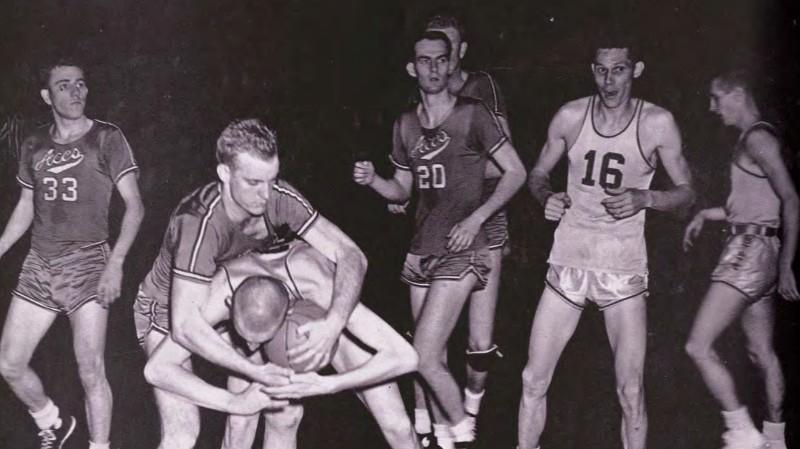

#16 (Retired) | 6'4" Forward | Central City, Ky.
Career Accolades & Hall of Fame Inductions
- 3x All-OVC Selection: 1951, 1952, 1953
- 3x All-OVC Tournament Team: 1951, 1952, 1953
- NAIA All-American: 1952
- All-OVC Baseball Selection: Outstanding Multi-Sport Star
- Murray State Athletics Hall of Fame: 1969 (Inaugural Class Era)
The Bluegrass Prodigy

Garrett Beshear was born on May 19, 1922, in Dawson Springs, Kentucky, and later moved to Central City, where his physical presence and soft shooting touch quickly made him a high school basketball standout. At 6-foot-4, Beshear possessed a rare combination of size and agility for the era. After serving his country during the World War II years, the mature forward arrived on campus in the late 1940s, right as head coach Harlan Hodges was building a regional powerhouse. Beshear immediately established himself as the premier offensive weapon in the newly formed Ohio Valley Conference (OVC).

Anchoring a Championship Dynasty
Playing alongside backcourt wizard Bennie Purcell from 1949 to 1952, Beshear anchored the most successful early stretch in Murray State basketball history. In the 1950–51 season, Beshear's dominant interior scoring propelled the "Breds" to a historic milestone: capturing both the OVC regular-season crown and the OVC Tournament championship. He was named to both the All-OVC and All-OVC Tournament teams, a feat he would replicate in three consecutive seasons.

During his junior year in 1951–52, Beshear's scoring reached national prominence. He spearheaded Murray State’s relentless march through the NAIB (now NAIA) National Tournament, carrying the team all the way to the national championship game. Though the Racers finished as national runners-up, Beshear’s spectacular tournament run earned him NAIA All-American honors, cementing his status as one of the elite forward prospects in the country.

The Historic Senior Campaign
While Purcell graduated in 1952, Beshear returned for a final, jaw-dropping senior campaign in 1952–53 that rewriting the scoring history books. His ability to take over games completely went on full display during a legendary winter stretch. In back-to-back games, Beshear exploded for 40 points against Dayton and another 40 points against Marshall, securing two marquee victories for the program in what remains one of the greatest individual scoring stretches in school history.

By the time he concluded his collegiate career, Beshear had racked up an astonishing 1,798 points across 117 games, averaging 15.4 points per game. At his peak, he averaged 23.8 points per game in a single season—a blistering mark that set a Murray State program record at the time. Beyond his scoring, he was a ferocious rebounder, tracking down 525 career boards. Proving his exceptional athletic versatility, Beshear also starred on the diamond for the Murray State baseball team, earning All-OVC honors as a multi-sport collegiate icon.

The Rafters of the CFSB Center
Beshear’s elite offensive production caught the eyes of professional scouts, leading to his selection by the Syracuse Nationals in the 12th round of the 1953 NBA Draft. However, his profound impact on the Murray State community remains his lasting legacy. In 1953, just one year after Purcell’s No. 21 went into the rafters, Murray State retired Beshear's No. 16 jersey. It was only the second retired number in program history.
Following his playing days, Beshear dedicated his life to mentoring the next generation of athletes. In 1954, he accepted the position of head basketball coach at the local University School in Murray, a role he passionately held for over a decade. Tragically, Beshear’s life was cut short when he passed away on July 24, 1968, at the young age of 46. In May 1969, Murray State permanently honored his greatness by posthumously inducting him into the Murray State Athletics Hall of Fame. Today, his No. 16 jersey continues to hang proudly inside the CFSB Center, forever commemorating a true pioneer of Racer basketball.