Hector Blondet: The Free-Spirit
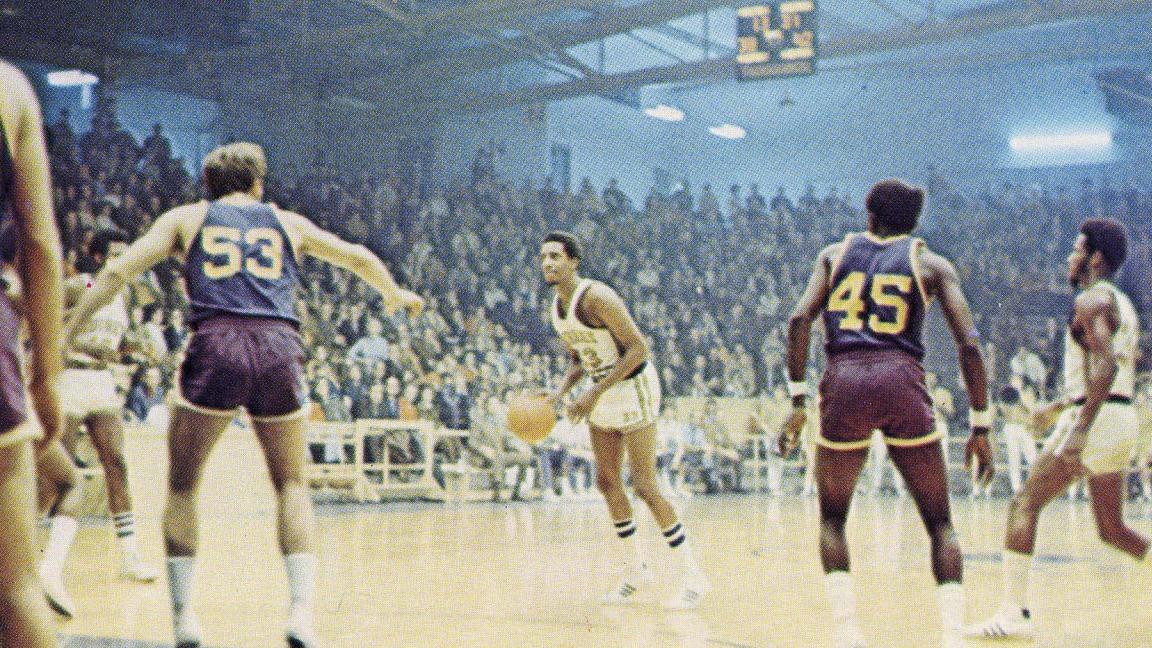
#33 | 6'4" Guard/Forward | Brooklyn, N.Y.
Career Accolades & Hall of Fame Inductions
- All-OVC Selection: 1969
- OVC Regular Season & Tournament Champion: 1970
- Río Piedras Sports Hall of Fame: Class of 2001
- Puerto Rico Sports Hall of Fame: Class of 2004
- 2x Olympian: 1972 (Munich), 1976 (Montreal)
From Rucker Park to Paducah
Hector Blondet was born in Brooklyn, New York, the youngest of five children of Puerto Rican immigrants. From early childhood he excelled on the athletic fields, originally projecting as a standout baseball pitcher. However, at age thirteen, the siren song of the asphalt courts captured his attention, and he pivoted completely to basketball. After one year at St. John's College Preparatory, he transferred to Boys High School in Brooklyn—the absolute premier proving ground for New York basketball at the time. This elite environment allowed Blondet to hone his game in the legendary Rucker Basketball Tournaments, competing directly against icons like Kareem Abdul-Jabbar, Tiny Archibald, Dean Meminger, and Connie Hawkins.
Following high school, Blondet boarded a bus out of Brooklyn and headed south to Paducah Community College in Western Kentucky. He dominated the junior college circuit for one season, averaging 17 points per game. His unique combination of playground flair and physical athletic tools caught the eye of Murray State head coach Cal Luther, who successfully convinced the New York product to transfer to the Thoroughbreds.
The 'Free Spirit' and the Hardwood Ups and Downs

Blondet’s transition to Division I basketball started slowly, but he quickly emerged as a dynamic star. During the 1968–69 season, he helped drive the Racers toward regional prominence, earning All-OVC honors. His sophomore campaign concluded on a major national stage, with Blondet dropping 15 points in a hard-fought NCAA Tournament battle against Al McGuire's powerhouse Marquette squad.
The following 1969–70 season, however, proved to be a tumultuous rollercoaster for the enigmatic star. Blondet started the campaign with an offensive blaze, but was suspended in January for "academic deficiencies and a violation of training regulations," forcing him to miss three games. He returned briefly, only to be suspended again two games later—this time for the remainder of the season. His college career easily could have ended there, but after the season concluded, Blondet sat down with Coach Luther. The two came to a profound mutual understanding. "He's a free spirit," Luther later reflected warmly. "In fact, I have liked very few of my players more than I like him."

Rocks and Resilience in Puerto Rico
Following the emotional ups and downs of his junior year, Blondet traveled to Puerto Rico to play summer basketball with the Arecibo Captains (Capitanes de Arecibo). It wasn't smooth sailing. Initially, local officials declared him ineligible to play in the Baloncesto Superior Nacional (BSN) league, forcing Blondet into a courtroom to produce legal documents proving his parents were born on the island to claim his eligibility.
Even after winning his legal battle, the local media and fans treated the outsider with deep skepticism. "The papers said 6'8", 250-pound Hector Blondet was coming down to tear up everybody. So I showed up at 6'4" and a skinny 185 pounds. With my 'natural' hairstyle and thick lips, those people refused to believe I was Puerto Rican," Blondet recounted to the Louisville Courier-Journal. "And the fans, who were expecting some giant after reading the papers, threw rocks at me all summer."
But once the games actually began, Blondet caused an absolute sensation. He revolutionized the league by unveiling a daring, improvisational passing style and a flashy, high-flying brand of basketball that had simply never been seen in Puerto Rico before. By the end of the summer, the rock-throwing crowds were converted into adoring fans.
The Top 25 Senior Resurgence
Blondet returned to Murray State for his 1970–71 senior season a completely transformed man. He had married, was eagerly expecting a child, and after being voted co-captain by his teammates, felt a profound responsibility to set an elite example for the younger players. Led by Blondet and fellow captain Jimmy Young, the Racers came out of the gate like a house of fire.
The defining moment of the season arrived inside a raucous Racer Arena, where the Breds shocked the nation by defeating the 7th-ranked Western Kentucky Hilltoppers in an epic 73–71 thriller. The victory catapulted Murray State into the National Top 25, climbing as high as No. 17 in the country before late-season injuries to both Blondet and sophomore star Les Taylor derailed the team's momentum over the final five games. Blondet finished his stellar collegiate career ranked 9th all-time in career points, 20th in points per game, and 1st in career field-goal percentage.

International Stardom and Olympic Glory
Following graduation, Blondet’s exceptional talent was recognized across both professional drafts. He was selected by the Portland Trail Blazers in the 5th round of the 1952 NBA Draft and by the Virginia Squires in the 10th round of the ABA Draft. Though he initially signed with Portland, Blondet ultimately chose to return to Puerto Rico to fulfill a deeper calling: representing the Puerto Rican National Team on the global stage.
Blondet instantly became an international icon. He led Puerto Rico to a historic silver medal at the 1971 Pan American Games in Cali, Colombia. Next came the legendary 1972 Summer Olympics in Munich. Blondet put on an absolute masterclass, driving his squad to an elite 6th-place Olympic finish. His individual brilliance was so undeniable that journalists across both the United States and Europe officially recognized him as one of the most outstanding and dazzling players of the entire Olympiad.
Blondet returned to the island to anchor the Arecibo Captains until 1974, continuing to represent his country at the 1974 FIBA World Championship (Mundobasket) and the 1976 Summer Olympics in Montreal. In 1976, he signed with the Río Piedras Cardinals, instantly leading the franchise to a BSN League Championship victory, followed by another finals appearance the next year. Over his historic 14-year career in Puerto Rico, Blondet averaged 16.3 points, 6.6 rebounds, and 3.2 assists per game. His legendary impact on international basketball was permanently immortalized with his induction into the Río Piedras Sports Hall of Fame in 2001 and the Puerto Rico Sports Hall of Fame in 2004.